Georgia
Georgia's Nov 15 Copper Date Has Passed: Now What?
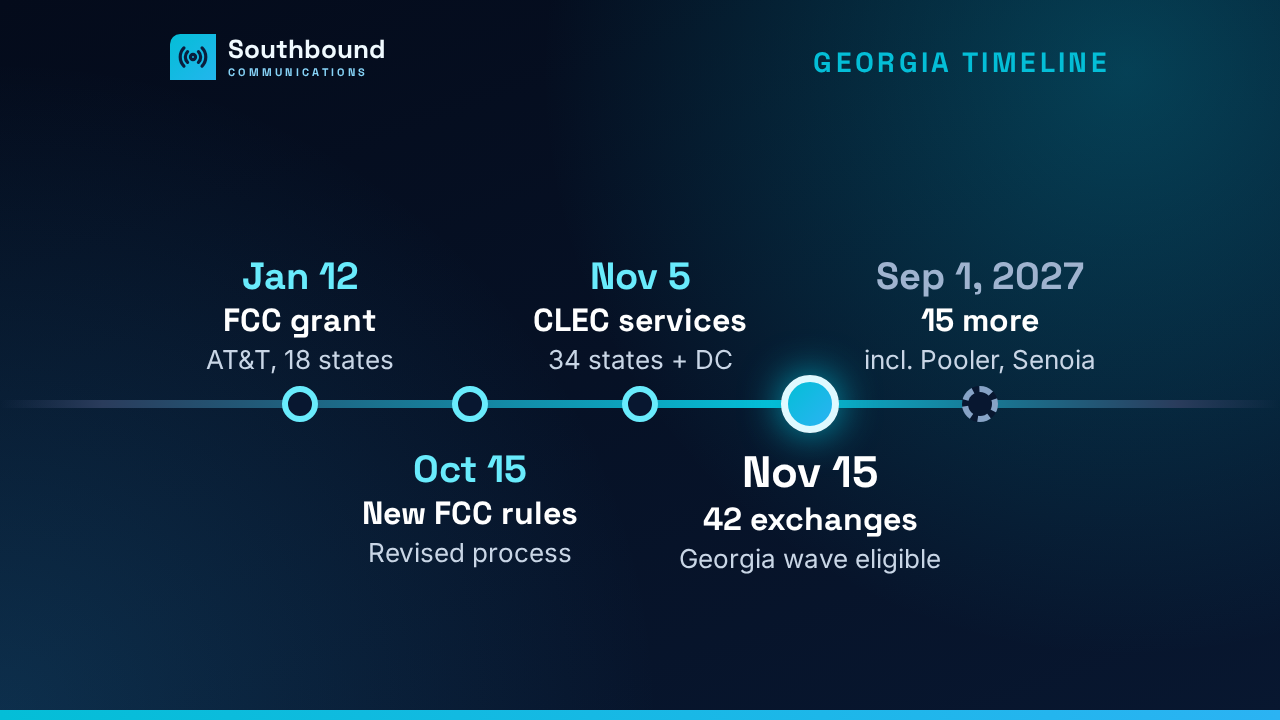
November 15, 2026 has passed. AT&T was authorized to discontinue legacy copper phone service, or POTS, on or after that date in portions of 42 Georgia exchanges. If your lines still work, that alone tells you nothing about how much time remains.
The AT&T application, covering 18 states, was automatically granted on January 12, 2026. The practical question for your business is now specific: which services are affected, and what date does your carrier's notice give?
There is no nationwide federal POTS shutoff date. There is also no universal 90-day customer notice guarantee in 47 CFR § 63.71. Treating either as your planning calendar can leave essential lines exposed.
The 42 Georgia exchanges in AT&T's November 15 wave
The filing identifies affected wire centers by exchange name. The 42 exchanges below include Gay, Newton and Wilmington Island.
| Area code grouping | Exchanges |
|---|---|
| 229 | Americus, Baconton, Camilla, Colquitt, Cordele, Leary, Leesburg, Newton, Pelham, Smithville, Sylvester |
| 912 | Baxley, Blackshear, Claxton, Hazlehurst, Jekyll Island, Jesup, Lyons, Tybee Island, Vidalia, Wilmington Island |
| 478 | Cochran, Dublin, Eastman, Louisville, Millen, Sandersville, Wadley, Wrightsville |
| 706 / 762 | Gay, Gibson, Greenville, Rutledge, Warrenton, Wrens |
| 770 / 678 / 470 | Bowdon, Buchanan, Grantville, Kingston, Roopville, Tallapoosa, Zebulon |
The filing covers portions of wire centers, rather than entire towns. These are copper-only, non-fiber portions. A fiber-served location in a listed exchange may be outside this discontinuance.
Use the area code groupings to organize an inventory, not to decide eligibility. Match actual service addresses and phone numbers to the carrier's notice. An exchange name or a ZIP code alone cannot settle whether an individual circuit is affected.
What "on or after November 15" means now
The authorized starting date has passed. That does not establish that every affected line stopped working on November 15, 2026, or that every remaining customer has the same migration date. Your carrier's own notice supplies the deadline to plan around.
A working dial tone should prompt verification, rather than reassurance. Locate the notice, confirm the covered numbers and services, and resolve any mismatch between the letter and your invoices with the carrier.
Grandfathering also offers no price protection. An existing copper service can remain active while its rate changes. Review both the service deadline and the bill before deciding to leave an apparently working line alone.
Why "90 days" is the wrong assumption
47 CFR § 63.71 sets customer-notice content requirements. It does not establish a fixed 90-day retail customer notice period. References to 90 days can reflect carrier practice or conditions attached to a particular order. They are no substitute for reading your own notice.
The rule also contains procedural clocks that are easy to confuse with customer migration time:
- 15 days: the non-dominant-carrier comment window under § 63.71. This concerns comments on a discontinuance application.
- 31 days: the streamlined automatic-grant period applied to discontinuance applications under the revised FCC framework. The FCC can remove an application from automatic processing.
These clocks concern regulatory review. Neither gives your business a fresh period to migrate after receiving a letter or after an authorized discontinuance date passes.
The revised discontinuance rules took effect on October 15, 2026. The November 15 wave had already been granted on January 12, 2026, under the earlier rules. Do not apply the newer 31-day framework retroactively to explain that approval.
Public participation can still matter in other proceedings. On September 25, 2026, the FCC pulled Verizon's separate nine-state legacy-voice application from automatic processing. That does not reopen AT&T's already-granted November 15 wave.
A practical plan for affected Georgia locations
Find the notice and reconcile the lines
Pull invoices and any discontinuance letters for each location. Build one list containing the carrier, account, number, service address, function, monthly charge and notice deadline. Confirm uncertain dates directly with the carrier.
Do not assume that a location outside these 42 exchanges is clear of every copper change. Georgia has other AT&T waves and smaller road-construction discontinuance slices. Each needs its own service-level check.
Identify what every line supports
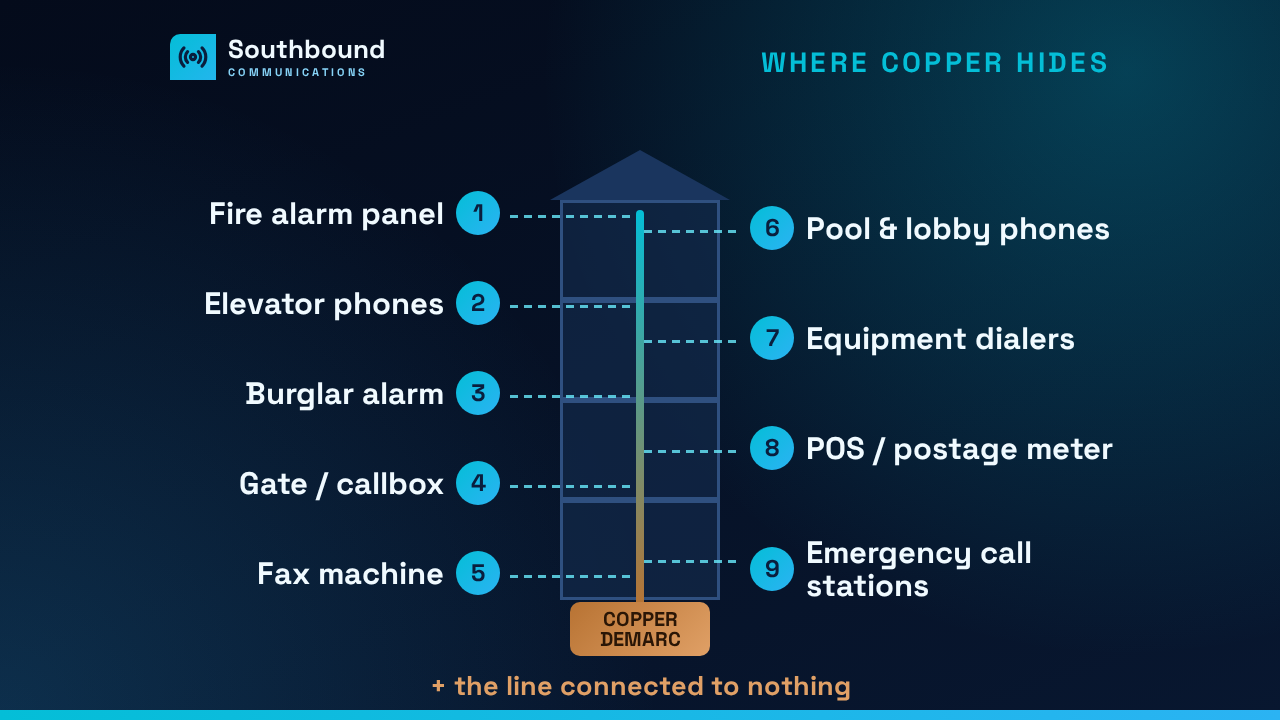
Trace analog lines to their equipment: desk phones, fire panels, elevator phones, burglar alarms, gates, fax machines and payment terminals. Flag unidentified lines for investigation before cancellation.
Prioritize life-safety functions. A replacement that carries ordinary voice calls may still be unsuitable for alarm signaling or elevator communications. Verify the actual application before placing an order.
Choose and test a path for each function
Compare hosted voice, SIP trunking, managed cellular analog service and fiber or broadband with managed analog voice against the inventory. A mix may fit better than moving every line to the same service.
For fire alarms, review UL 864 listing, supervision and secondary power requirements with the monitoring provider. Elevator communications have their own ASME A17.1 requirements. The Authority Having Jurisdiction makes the site-specific compliance determination.
Schedule installation and functional testing against the notice deadline. Keep cancellation decisions tied to verified device dependencies and successful testing, rather than the presence of a new dial tone.
Two related dates for Georgia businesses
- November 5, 2026: AT&T's CLEC affiliates were authorized to discontinue PrimePath and Business Local Exchange Service, including ABN, OneNet and ACC Business offerings, on or after this date in 34 states plus DC, including Georgia.
- September 1, 2027: a further AT&T wave covers 15 Georgia exchanges, including Morrow, Palmetto, Loganville, Senoia and Pooler near Savannah. That application passed its FCC automatic-grant date on October 22, 2026.
Frequently asked questions
My lines still work. Can I wait for another warning?
Do not assume another warning will arrive. Read the existing carrier notice and verify the affected services and deadline. The November 15, 2026 authorized starting date has already passed.
Does § 63.71 guarantee 90 days to replace service?
No. It sets notice content and regulatory procedures, not a universal 90-day retail notice guarantee. Carrier practice and individual order conditions vary. Your own notice is the planning reference.
My town appears above. Is every business affected?
No. The filing covers portions of wire centers. Confirm individual service addresses and numbers with the carrier instead of relying on a town name or area code.
Can I use ordinary hosted voice for a fire panel?
Hosted voice is generally not appropriate for alarm panels or ring-down. Fire alarm communications require application-specific review, including listing, supervision and backup power. Involve the monitoring provider and obtain the required AHJ sign-off.
Get a free copper exposure audit
Southbound Communications is an Atlanta-based, vendor-neutral telecom advisor. We start with your inventory, costs and service requirements before comparing migration paths.
Our free copper exposure audit helps identify what each line supports, what it costs and which carrier notices need attention. Bring your invoices and letters so we can build a line-by-line plan.
Request your free copper exposure audit.
Sources
- AT&T discontinuance application, Exhibit 1 and customer notices, WC 25-335, Florida PSC document 15393-2025.
- 47 CFR § 63.71, discontinuance application and customer-notice requirements.
- FCC 26-19, Network and Services Modernization Order.
- Federal Register, October 15, 2026 effective date for revised discontinuance rules.
- FCC DA 26-1038, Verizon application removed from automatic processing, September 25, 2026.
- FCC DA 26-1011, AT&T wave with discontinuance on or after September 1, 2027.
- FCC DA 26-1075, AT&T CLEC business local exchange discontinuance.